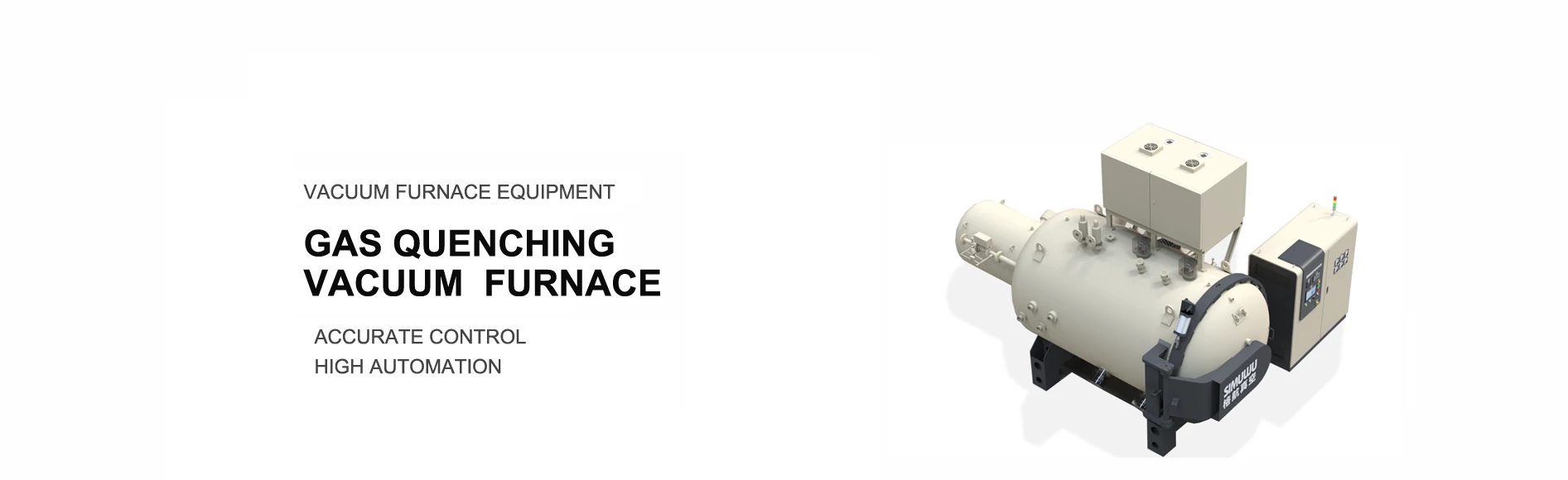
Please send us your inquiry about the customization of other furnace types or related questions about vacuum furnace. We will reply you immediately. Thank you.
Email: contact@vacfurnace.com
Tel : +86-21-50878190
Address: NO.1299, XinJinQiao Road, Pudong New Area, Shanghai, China.


Heat Treatment Process of Cr12MoV Steel Cold Extrusion Die
Cr12MoV steel is one of the most commonly used mold steels in my country. Because of its high hardness, high strength, and small volume deformation during heat treatment, it is mostly used for high-load, high-precision, and long-life cold-deformed molds. At present, there are many factors that ca...
The Role of Heat Treatment In the Reducer
Heat treatment is a very important link in the manufacture of reducer, but many users do not understand the role of this heat treatment, so in order to facilitate everyone’s understanding, the following is an introduction to its role. 1. Surface Quenching Common surface quenching methods in...
Pit Furnace Gas Nitriding Process Operation
1. Preliminary Treatment Determination Principle General structural steel parts are quenched and tempered. The high-temperature tempering temperature should be 20-40ºC higher than the nitriding temperature, and the holding time should not be too long. Normalizing can be used for parts with low im...
The Difference Between Hard Nitriding and Soft Nitriding
Hard Nitriding Nitriding is a type of chemical heat treatment, also known as nitriding, which refers to placing the workpiece in a nitrogen-containing furnace gas (ammonia-containing gas), selecting an appropriate temperature, gas flow, ammonia concentration ratio, etc., and maintaining it for a ...
Development of Debinding Technology
The origin of PIM technology can be traced back to the manufacture of ceramic spark plugs in the late 1920s, but the early development was very slow, and mass production and market did not form. CIMdebindingin the early 1940s and 1940s adopted the Bendix process. The main components of the binder...
Application of SPS Sinter in the Development of New Materials
Its typical applications mainly include the following type of materials . 1. Intermetallic compounds Intermetallic compounds can effectively utilize temperature brittleness and high melting point, so their preparation requires a special process. Using the SPS method to prepare intermetallic comp...
TC4 Solid Solution Water Quenching Heat Treatment Process
Titanium alloys can be divided into a titanium alloy, β titanium alloy and a+β titanium alloy according to their annealed state. Among them, a+β titanium alloy is the most widely used, and TC4 is a typical one. The main alloying elements of TC4 are AL and v, where AL is a stable a-phase element, ...
Structure and Characteristics of Vertical Vacuum Water Quenching Furnace
1. The structure diagram of the vertical vacuum water quenching furnace, as shown in Figure 1: Fig. 1 Vertical vacuum water quenching furnace structure diagram 2. The main technical parameters of the equipment are as follows: Maximum temperature: 1350 C; working range: 550 C~1250 C Temperature ...
What Conditions Need To Be Met For The Vacuum System Of The Vacuum Heat Treatment Furnace And What To Do If Steam Appears
The vacuum system of vacuum heat treatment furnace is generally composed of vacuum pump, vacuum valve, vacuum measuring instrument, pipeline and other parts. 1. Vacuum system with mechanical booster pump is suitable for vacuum heat treatment furnace with vacuum degree of 1.33-3×10 in the negative...
Precautions For Heat Commissioning And Heating Of Vacuum Heat Treatment Furnace
The characteristics of the vacuum heat treatment furnace with strict vacuum sealing, most heating and insulation material can only be used in the vacuum state, water cooling device, vacuum heat treatment furnace, furnace shell, furnace cover, electric heating element guide don’t treat (wate...